
POY
POY (Partially Oriented Yarn) – Technical Specifications
1. What is POY?
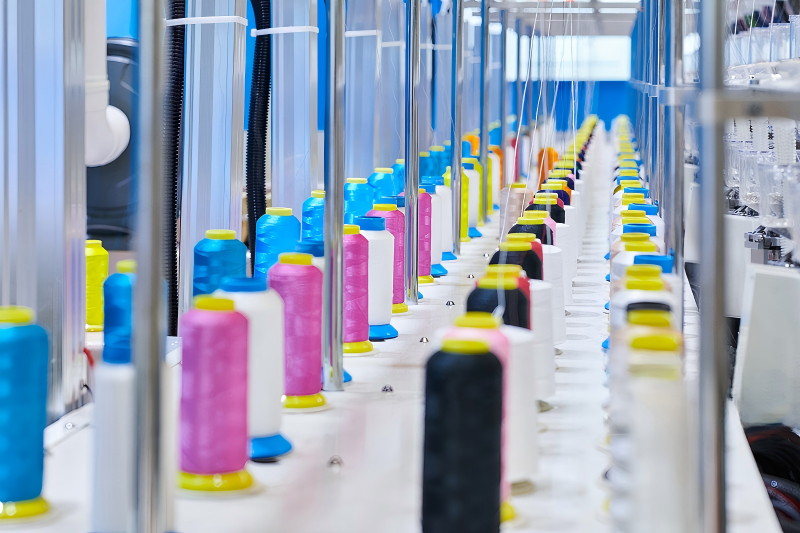
POY (Partially Oriented Yarn), also known as polyester pre-oriented yarn, is a filament yarn produced by high-speed spinning (typically 3,000 – 4,000 m/min). Unlike FDY which is fully drawn, POY is only partially oriented, meaning its molecular chains are aligned to some extent but not fully stretched. This intermediate state gives POY excellent storage stability and makes it the ideal precursor for producing DTY (Draw Textured Yarn) through further drawing and texturing processes.
2. Applicable Standards
-
Industry Standard: FZ/T 54133-2022 “Antimony‑free polyester partially oriented yarns (POY)” – applies to round-cross-section, semi-dull antimony-free POY with total linear density from 55 dtex to 600 dtex and monofilament linear density from 0.8 dtex to 8.0 dtex, used for draw-texturing and drawing.
-
Industry Standard: FZ/T 54058-2012 “Polyester partially oriented/drawn bi-shrinkage filament yarns” – applies to POY/FDY bi-shrinkage yarns with total linear density from 30 dtex to 400 dtex and monofilament linear density from 0.5 dtex to 5.6 dtex.
-
Group Standard: T/ZZB 2900-2022 “Polyester partially oriented yarns” – applies to POY with total linear density from 20 dtex to 1,500 dtex and monofilament linear density from 0.3 dtex to 10.0 dtex.
-
International Standard: ISO 12834:2024 “Textiles – Synthetic filament yarns – Test method for dynamic thermal stress of partially oriented yarns (POY)” – developed by Tongkun Group, this standard describes the test method for dynamic thermal stress of POY with linear density below 800 dtex.
POY products are typically graded into AA (Superior), A (First-class), and Qualified grades.
3. Key Physical Properties
3.1 Linear Density (Fineness)
Linear density is expressed as “dtex/f” – e.g., 167 dtex/48 f means:
-
dtex: weight in grams of 10,000 meters of yarn.
-
f: number of individual filaments.
Common POY fineness range: 20 D ~ 1,500 D. DPF (denier per filament) can reach as low as 0.125 – 1.0 dtex.
3.2 Breaking Tenacity
Maximum tensile force the yarn can withstand before breaking, expressed in cN/dtex.
-
Typical range: 2.0 – 2.5 cN/dtex.
-
Some sources indicate minimum ≥ 2.5 g/denier.
-
Bright POY products may have tenacity around 2.53 cN/dtex.
Significance: POY has lower tenacity compared to FDY because it is not fully drawn. This allows it to be further processed (drawn and textured) into DTY with higher strength.
3.3 Elongation at Break
Percentage of elongation at the moment of breaking.
-
Typical range: 110% – 150%.
-
Some products may have elongation around 120% – 130%.
-
Typical average: ~130%.
Significance: POY has high elongation due to its partially oriented molecular structure. This high extensibility is essential for downstream drawing and texturing processes.
3.4 Boiling Water Shrinkage
Shrinkage rate after treatment in 100°C water.
-
Typical range: 55% – 65%.
Significance: High shrinkage reflects the low orientation and high potential for further drawing, which is a key characteristic of POY.
3.5 Oil Pick-Up (OPU)
Oil content on the yarn for lubrication, antistatic, and fiber cohesion functions.
-
Typical range: 0.30% – 0.40%.
3.6 Evenness (Uster Value – U%)
Measures the uniformity of the yarn.
-
Typical requirement: < 1.2%.
-
Typical achieved range: 0.72% – 1.14%.
Significance: Good evenness ensures consistent dyeing and processing performance in downstream operations.
3.7 Molecular Orientation
-
Typical range: 60% – 70%.
This intermediate orientation level is what defines POY and enables its subsequent processing into DTY.
4. Common Specifications & Typical Parameters
Below is a reference table based on industry data:
| Specification | Fineness (Dtex) | Tenacity (cN/dtex) | Elongation (%) | Oil Content (%) | Uster (U%) |
|---|---|---|---|---|---|
| 136D/36f | 136 ± | 2.40 – 2.58 | 120 – 124 | 0.32 | 0.72 – 1.14 |
| Bright POY | — | ~2.53 | ~129.8 | ~0.35 | ~1.04 |
Common POY Product Range (Semi-dull):
| Denier Range | Common Applications |
|---|---|
| 15D – 330D | Standard range for DTY production |
| 55D – 600D | FZ/T 54133-2022 scope |
| 20D – 1500D | T/ZZB 2900-2022 scope |
5. Optional Parameters
POY can be customized according to customer requirements:
| Parameter | Available Options |
|---|---|
| Luster | Bright, Semi-dull |
| Cross-section shape | Round, Trilobal, Triangular |
| Dyeing | Dope-dyed (various colors) |
| Special functions | Antibacterial, Flame-retardant, etc. |
6. Main Applications
POY is primarily used as an intermediate product for further processing:
-
DTY Production: POY is the primary feedstock for draw-texturing to produce DTY (Draw Textured Yarn).
-
FDY Production: POY can be further drawn to produce FDY (Fully Drawn Yarn).
-
Direct Weaving: Some POY products can be used directly in weaving applications.
-
Blended Yarns: Used in combination with other fibers for specialty yarns.
Processing Equipment: Suitable for high-speed texturing machines, including Type 800, Type 1000, 33H, S+Z, TMT automatic, and other mechanical equipment.