

DTY
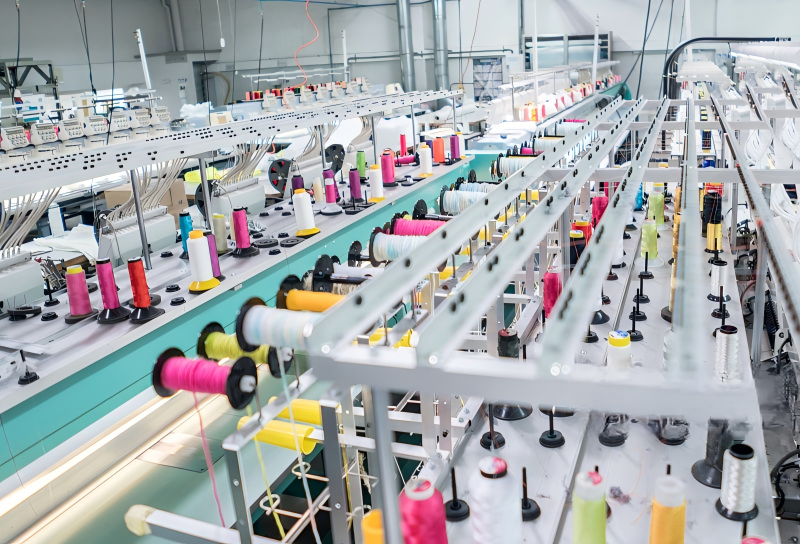
DTY (Tarraing Snáth Uigeachta) – Sonraíochtaí Teicniúla
1. What is DTY?
DTY (Polyester Drawn Textured Yarn) is a textured polyester filament yarn produced from PET chips. The process starts with high‑speed spinning to produce POY (Snáth Dírithe go Páirteach), which is then drawn and false‑twist textured. This process is efficient, cost‑effective, and yields high‑quality yarn with excellent bulk and stretch properties.
2. Caighdeáin is Infheidhme
-
Caighdeán Náisiúnta: GB/T 14460‑2015 “Polyester drawn textured yarn” (éifeachtach ó Aibreán 1, 2016), replacing GB/T 14460‑2008.
-
Caighdeán Tionscail: FZ/T 54134‑2022 “Antimony‑free polyester drawn textured yarn (DTY)” – applicable to round‑cross‑section, semi‑dull antimony‑free DTY with total linear density from 30 dtex chuig 350 dtex and monofilament linear density from 0.5 dtex chuig 5.6 dtex.
DTY is graded into Sármhaith (First), First‑class, agus Cáilithe products.
3. Príomh-Airíonna Fisiceacha
3.1 Dlús Líneach (Míne)
Linear density indicates yarn thickness. Expressed as “dtex/f” – m.sh., 167 ciallaíonn dtex/48 f:
-
dtex: meáchan i ngraim den 10,000 méadar snáth. 167 dtex = 10,000 m weighs 167 g.
-
Denier (D): another unit; conversion: 1 D = dtex / 1.11, so 167 dtex ≈ 150 D.
-
f: líon na bhfiliméad aonair (e.g., 48 f = 48 monofilaments).
Common DTY fineness range: 15 D ~ 1000 D, with filament counts from 24 f to 576 f.
3.2 Breaking Tenacity
Uasfhórsa teanntachta is féidir leis an snáth a sheasamh roimh bhriseadh, arna shloinneadh i cN/dtex.
-
Minimum requirement: generally ≥ 3.0 cN/dtex.
-
Raon tipiciúil: 3.0 – 4.8 cN/dtex.
-
Suntas: directly affects fabric tear strength and abrasion resistance. Low tenacity can cause weak fabrics and frequent breakage during weaving.
3.3 Fadú ag Sos
Céatadán elongation tráth an bhriseadh.
-
Raon tipiciúil: 18% – 30% (some products can be 25% ± 3%).
-
Lower elongation usually gives better dyeing uniformity, higher strength, and higher crimp contraction; excessive elongation can produce stiff filaments, reduce shrinkage, and cause difficulties in setting and wrinkling during dyeing and finishing.
3.4 Crimp Contraction
Indicates bulkiness and elasticity of DTY.
-
Regular DTY: generally ≤ 20%.
-
High‑elastic network yarn: around 30%.
-
Higher crimp contraction gives better bulk and fuller fabric hand.
3.5 Crapadh Uisce Fiuchphointe
Ráta crapadh tar éis cóireála in uisce 100 ° C.
-
Critical for downstream weaving and dyeing. Too high may cause length shortage but good setting; too low may lead to poor setting and wrinkling.
3.6 Oil Pick‑Up (STOMACH)
Oil content on the yarn, providing lubrication, fhrithstatach, antibacterial, and antioxidative functions.
-
Recommended levels by end‑use:
-
Warp yarn: ~1.0%
-
Knitting: ~1.5%
-
High‑tension weaving (rapier, jacquard): ≥ 2.5%
-
4. Sonraíochtaí Coiteann & Paraiméadair tipiciúla
| Sonraíocht | Fineness Tolerance | Breaking Tenacity | Fadú ag Sos | Ábhar Ola | Interlacing (N/m) |
|---|---|---|---|---|---|
| 150D/48f | ±2.5% | ≥3.1 cN/dtex | Center value ±6.0% | Center value ±0.30% | Center value ±6.0 |
| 250D/96f | ±2.5% | ≥3.2 cN/dtex | M% ±3% | M ±1.2% | M ±10 |
| 300D/96f | ±2.5% | ≥3.0 cN/dtex | 25±5% | ~2.0% | HIM 100±10 |
Nóta: “Center value” or “M” can be agreed between customer and supplier.
5. Paraiméadair Roghnacha
DTY can be customized according to customer requirements:
| Paraiméadar | Roghanna atá ar Fáil |
|---|---|
| Luster | Super bright, bright, semi‑dull, full‑dull |
| Cross‑section shape | Babhta, trilobal, flat |
| Interlacing level | Non‑interlaced (NIM), light, medium, heavy (DÉANAMH) |
| Twist | No twist, S‑twist, Z‑twist, S+Z |
| Crapadh | Low, medium, high |
| Leibhéal righneas | Low, normal, medium, high |
Interlacing degrees:
-
NIM (non‑interlaced): 0 – 10 snaidhmeanna/m
-
SIM (semi‑interlaced): 40 – 50 snaidhmeanna/m
-
DÉANAMH (high‑interlaced): 100 – 120 snaidhmeanna/m
6. Príomhiarratais
DTY is an ideal raw material for knitting (both warp and weft) agus fíodóireacht. Major end‑uses include:
-
Éadaí: suits, shirts, sportswear
-
Teicstílí baile: quilt covers, scaranna leapa, mosquito nets, curtains, sofa fabrics
-
Decoration: wall coverings, automotive interior fabrics
-
Industrial textiles: luggage fabrics, seat covers
Fine‑denier DTY (especially trilobal cross‑section) is suitable for silk‑like fabrics, while medium‑to‑coarse denier is used for wool‑like fabrics.