
FDY
FDY (Fully Drawn Yarn) – Technical Specifications
1. What is FDY?
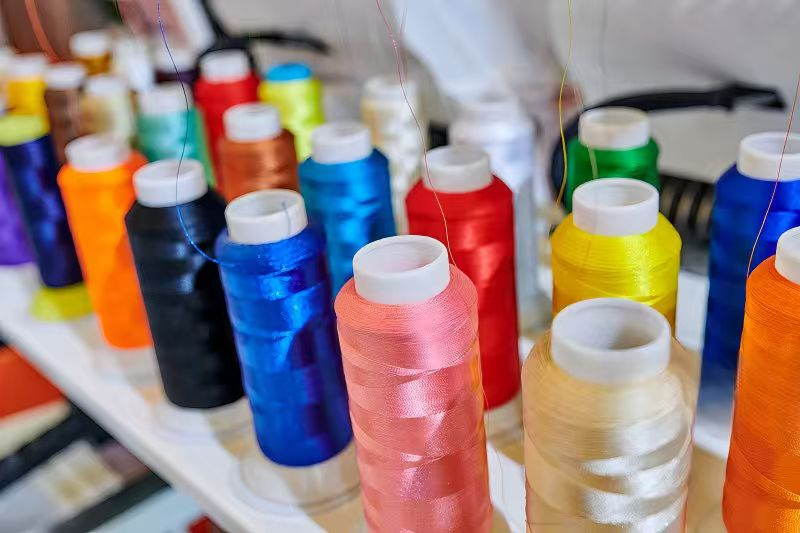
FDY (Fully Drawn Yarn), also known as polyester drawn yarn, is a fully oriented filament yarn produced by a one-step spinning and drawing process (spin-draw process). Unlike POY (Partially Oriented Yarn) which requires further drawing, FDY is already fully drawn and heat-set during manufacturing, resulting in a highly oriented molecular structure. FDY features high strength, low elongation, excellent dimensional stability, good smoothness, low static buildup, and outstanding dyeing uniformity.
2. Applicable Standards
-
National Standard: GB/T 8960-2015 “Polyester drawn yarns” (effective from April 1, 2016), replacing GB/T 8960-2008.
-
Scope: This standard applies to round-cross-section, semi-dull, and bright polyester drawn yarns with total linear density from 15 dtex to 1,110 dtex and monofilament linear density from 0.3 dtex to 7.0 dtex. Other types may refer to this standard.
FDY products are typically graded into AA (Superior), A (First-class), and Qualified grades.
3. Key Physical Properties
3.1 Linear Density (Fineness)
Linear density is expressed as “dtex/f” – e.g., 167 dtex/48 f means:
-
dtex: weight in grams of 10,000 meters of yarn.
-
f: number of individual filaments.
Common FDY fineness range: 15 D ~ 1000 D.
3.2 Breaking Tenacity
Maximum tensile force the yarn can withstand before breaking, expressed in cN/dtex or g/denier.
-
Typical range: ≥ 3.0 – 4.5 cN/dtex (or ≥ 4.5 g/denier).
-
High tenacity FDY variants can reach 7.8 – 8.0 cN/dtex.
-
Significance: FDY’s high tenacity makes it suitable for applications requiring durability and strength.
3.3 Elongation at Break
Percentage of elongation at the moment of breaking.
-
Typical range: 25% – 45%.
-
High-tenacity FDY typically has lower elongation: 15% ± 2%.
-
FDY has lower elongation compared to DTY, reflecting its fully drawn, high-orientation state.
3.4 Boiling Water Shrinkage
Shrinkage rate after treatment in 100°C water.
-
Typical range: varies by product; some specialty FDY can reach 32% ± 6%.
-
Critical for downstream weaving and dyeing processes.
3.5 Oil Pick-Up (OPU)
Oil content on the yarn for lubrication and antistatic functions.
-
Typical range: 0.4% – 0.8%.
3.6 Interlacing (Intermingling)
Controlled interlace points for improved yarn cohesion and processing performance.
-
Typical range: varies by application; specialty FDY can have 15 ± 5 knots/m.
-
Intermingled FDY yarns are suitable for direct twisting, warping, and weaving.
3.7 Color Fastness
| Fastness Type | Rating |
|---|---|
| Washing Fastness | Grade 4–5 |
| Light Fastness | Grade 5–8 |
4. Common Specifications & Typical Parameters
Below is a reference table based on industry data:
| Specification | Fineness (Dtex) | Tenacity (cN/dtex) | Elongation (%) | Oil Content (%) | Interlacing |
|---|---|---|---|---|---|
| 250D (example) | 275 ± 5 | > 2.5 | 140 ± 5 | 0.40% | — |
| 150D (example) | 167 ± 5 | > 3.0 | 25 ± 5 | 2% | — |
| 300D (example) | 335 ± 5 | > 3.8 | 38 ± 10 | 0.8% | HIM 100 ± 10 |
Note: FDY generally has lower elongation and higher tenacity compared to DTY.
Common FDY Product Range (Semi-dull FDY):
| Denier Range | Filament Count Options |
|---|---|
| 50D | 24F, 36F, 48F, 72F |
| 75D | 36F, 72F, 144F |
| 100D | 36F, 48F, 72F, 144F |
| 150D | 36F, 48F, 96F, 288F |
| 200–250D | 48F, 72F, 84F, 96F |
| 300D | 72F, 96F, 576F |
| 400–500D | 96F, 192F |
5. Optional Parameters
FDY can be customized according to customer requirements:
| Parameter | Available Options |
|---|---|
| Luster | Bright, Semi-dull, Full-dull |
| Cross-section shape | Round, Trilobal, Flat |
| Tenacity level | Standard, High-tenacity, Ultra-high-tenacity |
| Shrinkage | Low-shrinkage, Standard, High-shrinkage |
| Color | Raw white, Dope-dyed (various colors) |
6. Main Applications
FDY is widely used in apparel, home textiles, and industrial applications:
-
Apparel: suit fabrics, corduroy, silk-like fabrics
-
Home textiles: curtain cloth, sofa fabric, bedspreads
-
Industrial: ropes, webbing, sewing threads, coated fabrics, safety belts
-
Processing equipment: rapier looms, water jet looms, air jet looms, warp knitting machines
Fine-denier FDY is suitable for lightweight, high-end fabrics, while medium-to-coarse denier FDY is used for industrial and upholstery applications.