
DTY
DTY (Draw Textured Yarn) – Technical Specifications
1. What is DTY?
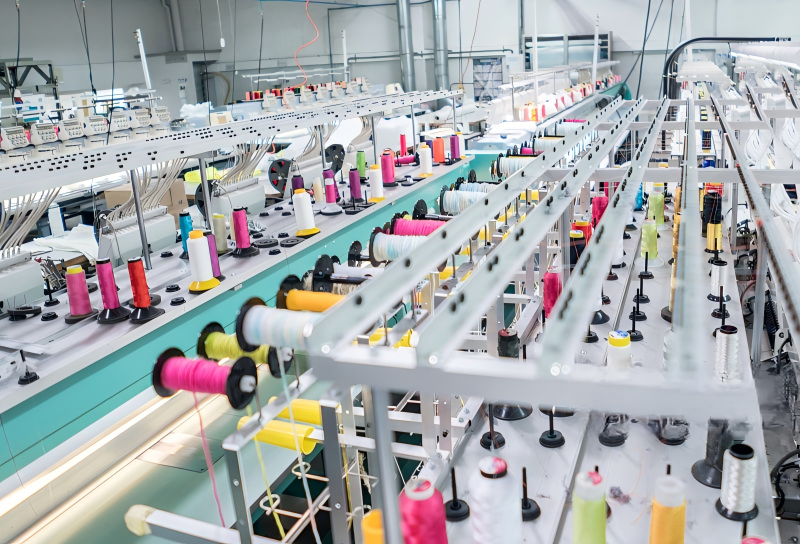
DTY (Polyester Drawn Textured Yarn) is a textured polyester filament yarn produced from PET chips. The process starts with high‑speed spinning to produce POY (Partially Oriented Yarn), which is then drawn and false‑twist textured. This process is efficient, cost‑effective, and yields high‑quality yarn with excellent bulk and stretch properties.
2. Applicable Standards
-
National Standard: GB/T 14460‑2015 “Polyester drawn textured yarn” (effective from April 1, 2016), replacing GB/T 14460‑2008.
-
Industry Standard: FZ/T 54134‑2022 “Antimony‑free polyester drawn textured yarn (DTY)” – applicable to round‑cross‑section, semi‑dull antimony‑free DTY with total linear density from 30 dtex to 350 dtex and monofilament linear density from 0.5 dtex to 5.6 dtex.
DTY is graded into Superior (First), First‑class, and Qualified products.
3. Key Physical Properties
3.1 Linear Density (Fineness)
Linear density indicates yarn thickness. Expressed as “dtex/f” – e.g., 167 dtex/48 f means:
-
dtex: weight in grams of 10,000 meters of yarn. 167 dtex = 10,000 m weighs 167 g.
-
Denier (D): another unit; conversion: 1 D = dtex / 1.11, so 167 dtex ≈ 150 D.
-
f: number of individual filaments (e.g., 48 f = 48 monofilaments).
Common DTY fineness range: 15 D ~ 1000 D, with filament counts from 24 f to 576 f.
3.2 Breaking Tenacity
Maximum tensile force the yarn can withstand before breaking, expressed in cN/dtex.
-
Minimum requirement: generally ≥ 3.0 cN/dtex.
-
Typical range: 3.0 – 4.8 cN/dtex.
-
Significance: directly affects fabric tear strength and abrasion resistance. Low tenacity can cause weak fabrics and frequent breakage during weaving.
3.3 Elongation at Break
Percentage of elongation at the moment of breaking.
-
Typical range: 18% – 30% (some products can be 25% ± 3%).
-
Lower elongation usually gives better dyeing uniformity, higher strength, and higher crimp contraction; excessive elongation can produce stiff filaments, reduce shrinkage, and cause difficulties in setting and wrinkling during dyeing and finishing.
3.4 Crimp Contraction
Indicates bulkiness and elasticity of DTY.
-
Regular DTY: generally ≤ 20%.
-
High‑elastic network yarn: around 30%.
-
Higher crimp contraction gives better bulk and fuller fabric hand.
3.5 Boiling Water Shrinkage
Shrinkage rate after treatment in 100°C water.
-
Critical for downstream weaving and dyeing. Too high may cause length shortage but good setting; too low may lead to poor setting and wrinkling.
3.6 Oil Pick‑Up (OPU)
Oil content on the yarn, providing lubrication, antistatic, antibacterial, and antioxidative functions.
-
Recommended levels by end‑use:
-
Warp yarn: ~1.0%
-
Knitting: ~1.5%
-
High‑tension weaving (rapier, jacquard): ≥ 2.5%
-
4. Common Specifications & Typical Parameters
| Specification | Fineness Tolerance | Breaking Tenacity | Elongation at Break | Oil Content | Interlacing (N/m) |
|---|---|---|---|---|---|
| 150D/48f | ±2.5% | ≥3.1 cN/dtex | Center value ±6.0% | Center value ±0.30% | Center value ±6.0 |
| 250D/96f | ±2.5% | ≥3.2 cN/dtex | M% ±3% | M ±1.2% | M ±10 |
| 300D/96f | ±2.5% | ≥3.0 cN/dtex | 25±5% | ~2.0% | HIM 100±10 |
Note: “Center value” or “M” can be agreed between customer and supplier.
5. Optional Parameters
DTY can be customized according to customer requirements:
| Parameter | Available Options |
|---|---|
| Luster | Super bright, bright, semi‑dull, full‑dull |
| Cross‑section shape | Round, trilobal, flat |
| Interlacing level | Non‑interlaced (NIM), light, medium, heavy (HIM) |
| Twist | No twist, S‑twist, Z‑twist, S+Z |
| Shrinkage | Low, medium, high |
| Tenacity level | Low, normal, medium, high |
Interlacing degrees:
-
NIM (non‑interlaced): 0 – 10 knots/m
-
SIM (semi‑interlaced): 40 – 50 knots/m
-
HIM (high‑interlaced): 100 – 120 knots/m
6. Main Applications
DTY is an ideal raw material for knitting (both warp and weft) and weaving. Major end‑uses include:
-
Apparel: suits, shirts, sportswear
-
Home textiles: quilt covers, bedspreads, mosquito nets, curtains, sofa fabrics
-
Decoration: wall coverings, automotive interior fabrics
-
Industrial textiles: luggage fabrics, seat covers
Fine‑denier DTY (especially trilobal cross‑section) is suitable for silk‑like fabrics, while medium‑to‑coarse denier is used for wool‑like fabrics.